The landscape of file storage and sharing in Microsoft 365 has evolved significantly in 2025, with major improvements to SharePoint and OneDrive.
Although both applications belong to the same collaborative suite, they continue to serve distinct purposes — yet now offer even deeper integration. OneDrive introduces new advanced search capabilities, while SharePoint strengthens team collaboration with optimized workflows.
With these recent Microsoft 365 updates, choosing between the two tools has become a more strategic decision for organizations looking to optimize their document management.
In this updated article, we’ll explore the latest features, commonalities, and differences between SharePoint and OneDrive to help you make the most of these advancements. You’ll discover their new capabilities, best use cases, and how to combine them effectively to meet your company’s modern collaboration and storage needs.
Are OneDrive and SharePoint the Same?
Think of a physical library:
Your OneDrive is like your personal office, where you keep your own work documents, while SharePoint represents the shared spaces where teams collaborate on joint projects.
These two Microsoft 365 applications naturally complement each other in everyday use.
Files stored in your OneDrive remain private until you choose to share them, whereas SharePoint team sites are designed for real-time collaboration between colleagues.
One important thing to remember: when an employee leaves the company, their OneDrive documents become inaccessible.
That’s why MS Solutions recommends using SharePoint to store all files essential to your organization’s operations.
Common Features Across Microsoft 365
Microsoft 365 users appreciate the consistent, user-friendly experience shared by both storage solutions.
Their familiar interfaces allow intuitive navigation and quick adoption of core features.
File synchronization with your computer works the same way on both platforms. You also get identical real-time co-authoring capabilities for Office documents, whether you’re working from SharePoint or OneDrive.
Both environments offer version control and file recovery for deleted items, ensuring data integrity and continuity.
This uniformity of core features makes it easy to switch between your personal workspace and collaborative team areas.
File Storage and Synchronization
When a team member edits a document on their computer, the changes are automatically reflected in the Microsoft 365 cloud.
This two-way synchronization ensures that everyone always works on the latest version of every file.
OneDrive provides each user with 1 TB of personal storage for business documents.
The Files On-Demand feature helps save disk space by downloading only the files you need.
SharePoint libraries, once synchronized, appear in your Windows File Explorer under your organization’s name.
You can easily drag and drop files between your OneDrive and SharePoint collaborative spaces, while maintaining existing access permissions.
Comparing Key Features
Although they share many similarities, the two Microsoft 365 tools stand out in specific areas:
SharePoint excels in advanced document workflows, with customizable approval and validation processes. Teams can design complex workflows tailored to their business needs.
OneDrive shines with its simplicity of sharing and fast synchronization for personal files. Its Personal Vault feature provides an extra layer of security for sensitive documents through enhanced authentication.
MS Solutions helps organizations leverage the best of both tools:
SharePoint offers template libraries and custom metadata, while OneDrive simplifies file version recovery for up to 30 days.
Advantages and Limitations of Each Solution
Think of OneDrive as your personal digital workspace — a flexible environment where you can manage your own work documents, share them quickly with a few colleagues, and access them even offline.
SharePoint, on the other hand, shines in team project organization.
Shared libraries can handle up to 30 million files, compared to 50,000 for OneDrive. This scalability comes with advanced metadata and workflow options for efficient document management.
However, note that OneDrive has a synchronization limit of 300,000 items across all locations.
To maintain optimal performance, MS Solutions recommends using SharePoint’s web interface rather than syncing all libraries locally.
Document Security and Sharing
Protecting sensitive data begins with rigorous access control management.
MS Solutions advises applying distinct security settings depending on the nature of your documents.
For confidential files in OneDrive, enable two-factor authentication and restrict sharing to specific users.
You can also set expiration dates for shared links to maintain full control over access.
SharePoint enhances your security with advanced encryption and audit features.
You can track exactly who accesses your documents and assign permissions by user group.
Disabling external sharing for certain elements adds an extra layer of protection for your organization’s strategic information.
Team Collaboration with SharePoint
Successful business projects rely on seamless collaboration among team members.
SharePoint team sites allow you to centralize resources and efficiently organize collective work by department or project.
Imagine a workspace where every document edit is instantly visible to all stakeholders.
Shared libraries enable real-time co-authoring, and custom metadata helps you quickly find relevant information.
Integrated approval workflows streamline document validation.
Managers can monitor progress and receive automatic notifications at every step, improving team productivity and oversight.
When to Use OneDrive
Working on a confidential report that’s not ready to be shared with your team yet?
OneDrive is your best ally for managing personal work-in-progress documents.
OneDrive’s flexibility is especially valuable during the early stages of a project — draft your documents, outline your ideas, and refine presentations in your private space before moving them to SharePoint for team collaboration.
MS Solutions also recommends using OneDrive to store personal administrative documents such as performance reviews or expense reports.
Automatic synchronization ensures you always have access to these sensitive files, even while traveling.
If you’d like to learn more about optimizing these tools for your organization, explore our Microsoft 365 training programs or contact our expert team for personalized support.
Migrating to SharePoint: Key Steps
Migrating to SharePoint is like planning a well-organized move — every item must be sorted, packed, and transferred carefully.
MS Solutions provides personalized support to simplify this transition.
Using the SharePoint Migration Tool (SPMT) allows you to securely transfer your data.
Start by identifying essential files to migrate and cleaning up obsolete content.
Then structure your new environment with libraries tailored to your organization.
Once the migration begins, we verify the integrity of transferred data and train your teams on the new features.
This structured approach ensures a smooth and successful transition to your modern collaborative workspace.
Integration with Microsoft Teams
The power of Microsoft Teams lies in its native integration with both SharePoint and OneDrive.
With a single click in the “Files” tab of any Teams channel, you can access all your stored documents across both platforms.
Team conversations become more productive thanks to real-time co-authoring.
You can edit a Word document directly within Teams while colleagues add their comments — without ever leaving the chat interface.
Your personal OneDrive files remain accessible from the “Files” tab, while documents shared in a Teams channel automatically sync with the team’s SharePoint site.
This seamless integration transforms Teams into a true central hub for daily collaboration.
In short …
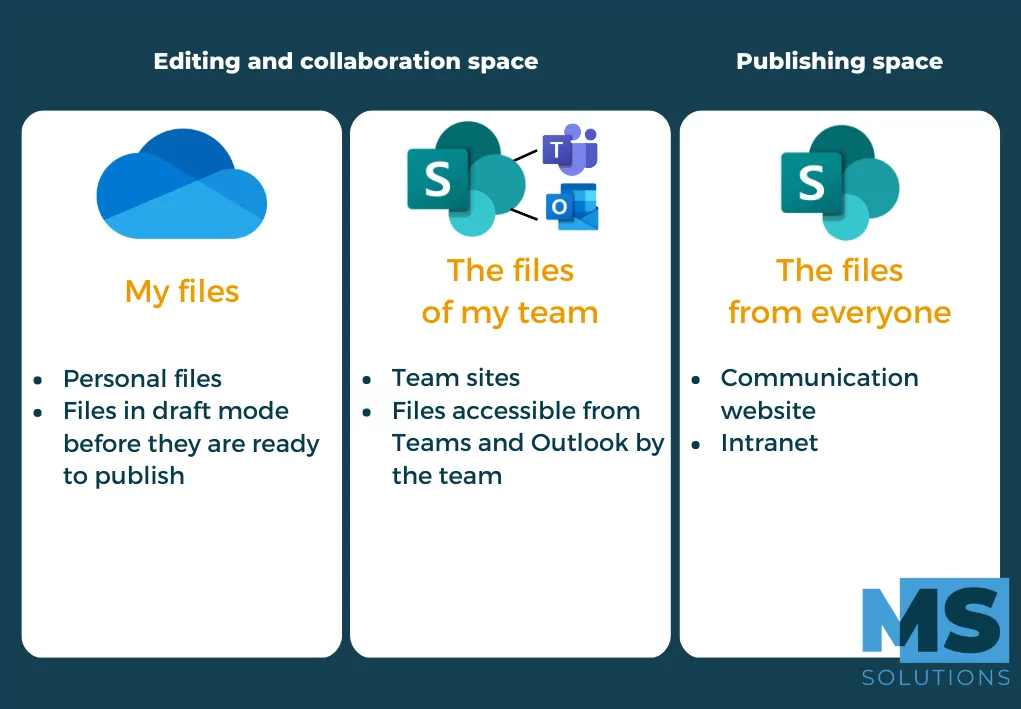
Although these two applications have commonalities in that they are both interconnected Microsoft applications, they have a very different usefulness depending on the context of use.
We will remember that OneDrive has a personal utility, while your team SharePoint allows collaboration. Finally, public SharePoint will be favored for consultation files that concern the group.
You want to go further with these tools, know that we offer training for the Microsoft 365 suite live. Do not hesitate to contact our team for more information.