Summer Holidays and Cybersecurity: Why Cybercriminals Love the Summer Season
While you’re planning your vacation, cybercriminals are busy planning their attacks. Summer represents a major blind spot for organizations: reduced staff, lower vigilance, and a surge in targeted cyberattacks. This article reveals why hackers love summer, the threats you should watch for, and, most importantly, how to effectively protect your organization.
Summer: A Critical Time for Cybersecurity
Reduced teams and decreased vigilance
When your employees go on vacation, who’s left in charge of your cyber defense? It’s a bit like leaving your house unattended for three weeks. IT teams slow down, replacements are less familiar with security protocols, and incident response times increase dangerously.
Response times can stretch from a few days under normal circumstances to several weeks during the summer. Meanwhile, cybercriminals have plenty of time to explore your systems, encrypt your data, or exfiltrate sensitive information. Organizations are left with skeleton crews managing major incidents without their usual expertise.
Unsecured personal devices on the move
This is where things get complicated. During the summer, many employees use personal devices to access work emails over unsecured public Wi-Fi networks. These connections are a wide-open door for cyberattacks. Public Wi-Fi allows cybercriminals to intercept business traffic or compromise devices with ease. Without proper business cybersecurity measures in place, every connection from a café or hotel becomes a vulnerability.
Targeted cyberattacks during holidays
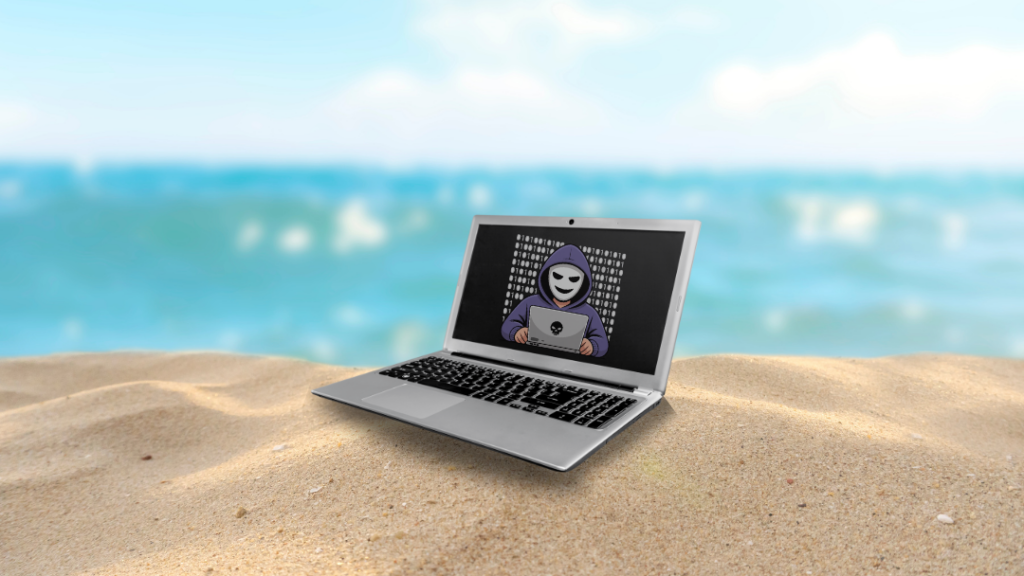
Here’s an uncomfortable truth: cybercriminals never take vacations. In fact, they love summer. Why? Because they know exactly what’s happening inside your organization during this time.
The statistics speak for themselves: 30% of companies report a noticeable increase in cyberattacks during holidays, vacations, and weekends. Attackers strategically target these moments when defenses are weaker, teams are distracted, and security measures operate in degraded mode. While you enjoy the sunshine, they deploy ransomware. Every year, the summer season becomes a preferred playground for malicious actors who exploit these organizational gaps.
Summer Cyber Threats Targeting Businesses
Seasonal phishing and fake travel emails
Summer is peak season for email scams disguised as travel bookings. Fake flight confirmations, fraudulent hotel emails, non-existent vacation rentals… Seasonal phishing campaigns take advantage of your vacation mindset : a moment when you’re naturally less cautious.
Why does it work so well? Because when you’re relaxed, you let your guard down. An email about your upcoming flight or hotel reservation feels perfectly legitimate. In 2025, phishing attempts targeting vacation voucher holders reached thousands per week during peak summer periods. Scammers constantly adapt their tactics to bypass evolving security measures.
Ransomware exploiting staff absences
This is the most serious threat to your business: ransomware deployed while your team is on vacation. Cybercriminals strategically choose holiday periods to encrypt your data, fully aware that no one will respond quickly.
Attacks are typically launched at night, on weekends, or during holidays, when IT staff are absent or operating at minimal capacity. The result? Attackers have all the time they need to fully cripple your organization before anyone notices.
Social engineering amplified by social media
Posting your beach photos on Instagram? Cybercriminals love that. Your vacation posts provide valuable sensitive information: who’s away, for how long, and even reporting relationships within your organization.
This social engineering technique allows attackers to know exactly who to target and when. Social media reveals behaviors, habits, and connections. They can impersonate an executive traveling abroad to send urgent requests to employees still at the office. This creates highly personalized and far more convincing attack scenarios.
If you’d like to dive deeper into modern threats, check out our article on AI-related cybersecurity risks.
Summer Warning Signs to Watch
- Unsolicited hotel or flight booking confirmation emails
- Urgent requests from an executive who is supposed to be on vacation
- Links to unverified free public Wi-Fi networks
- Unusual messages from an absent colleague requesting sensitive information
- Security update notifications during holiday periods
- Emails regarding vacation voucher refunds or travel expense reimbursements
How to Protect Your Organization Before and During Summer
Plan a cybersecurity training session before employees leave
You know what’s better than travel insurance? Cybersecurity training before your employees head out on vacation.
This is the ideal time to raise awareness about seasonal phishing through simulation exercises. Those fake hotel booking or flight confirmation emails become more convincing every year. Take the opportunity to remind your teams of best practices on the road: use corporate VPNs only, avoid unsecured public Wi-Fi, and never store sensitive documents on personal devices.
Employee cybersecurity training is the best preventive investment you can make. In 2026, 95% of cyberattacks exploit human error. Training your teams is like locking every door in your organization before leaving for vacation.
Conduct a preventive cybersecurity audit
Imagine discovering a leak in your home while you’re on the other side of the world. That’s exactly what happens when a vulnerability is exposed during summer with reduced staff.
A pre-vacation cybersecurity audit helps you identify and fix vulnerabilities while your full team is still available. It assesses your entire digital ecosystem: authentication systems, firewall configurations, access management, backups, and software updates.
A preventive approach is always more cost-effective than emergency remediation. Test your systems in real-world conditions, simulate attack scenarios, and make sure your protection mechanisms actually work. A comprehensive audit gives you clear visibility on priority actions needed to strengthen your cybersecurity strategy.
Implement a crisis management plan
Here’s a tough question: if a cyberattack occurs tomorrow while your IT manager is camping without internet access, who does what?
A clearly documented and accessible crisis management plan is essential. And by “everyone,” that includes backups and temporary staff covering during the summer.
This plan should define roles, emergency contacts (internal and external), procedures based on incident types, and escalation thresholds. It should also include a business continuity plan to ensure rapid recovery of critical operations.
Risk management is not something you improvise in the middle of a crisis. Your plan must be tested before summer, and every team member should know where to find it and how to apply it.
Cybersecurity Solutions for a Worry-Free Summer
Cyber insurance as a safety net
Even with the best preventive measures, zero risk doesn’t exist. This is especially true in summer, when teams are smaller and cybercriminals step up their efforts. That’s where cyber insurance comes in :a financial safety net in case of an incident.
It covers emergency response costs, ransom payments, system restoration, and even business interruption losses. Combined with a Zero Trust cybersecurity approach which assumes no default trust and requires constant verification, you strengthen your overall security posture. Together, cyber insurance and Zero Trust create a defense-in-depth strategy that protects your organization even when things go wrong.
Managed cybersecurity for continuous monitoring
You can’t go on vacation with peace of mind if no one is watching the store. The solution? Outsource your cybersecurity to a specialized partner providing 24/7 monitoring, even while your team is on leave.
Managed cybersecurity and MDR (Managed Detection and Response) services offer real-time threat detection, rapid incident response, and specialized expertise that most organizations don’t have in-house.
With AI-powered monitoring and dedicated security analysts, threats are identified and neutralized before causing damage. You benefit from a team of experts working behind the scenes to protect your systems, data, and users throughout the summer. The message is clear: don’t wait for an incident to act. Prevention and proactive monitoring are your best allies for a trouble-free summer.
Frequently Asked Questions
Why is cybersecurity even more important in summer?
Summer creates a critical blind spot in cyber defense. With reduced teams, lower vigilance, and attackers strategically targeting this period, risks skyrocket. Incident response slows down, replacements are less experienced, and attacks increase precisely when your defenses are weakest. Cybersecurity must remain a priority 365 days a year, vacation or not.
What are the essential precautions before going on vacation?
Before unplugging, take concrete steps. First, update all systems and software to fix security vulnerabilities. Next, enable multi-factor authentication on all sensitive accounts for an extra layer of protection. Finally, deploy cloud security solutions to protect your data, even when employees connect from the beach. These simple actions can make all the difference.
How can you raise employee awareness of summer risks?
Cybersecurity awareness should be delivered through short, targeted sessions before employees leave. Organize phishing simulations to test reflexes against seasonal scams. Reinforce with visual reminders: office posters, email alerts, and mobile-friendly checklists. For a comprehensive approach, consider formal employee cybersecurity training. Well-trained employees are your strongest line of defense.
For more information contact us: Contact – MS Solutions